Industrial plants run on careful thermal control. Understanding how heat exchangers work is essential when equipment fails or can’t keep up with production demands. Batch delays, safety risks from overheating and higher utility bills trace back to inadequate heat transfer capacity.
Aging infrastructure and increased production demands create ongoing challenges. Fouling, corrosion, tube failures and material degradation from high-temperature operations shorten service life. When replacement becomes necessary, new equipment lead times can stretch to six months or longer, depending on the market and supplier.
Used heat exchangers from reputable suppliers deliver reliable performance on faster timelines, helping you avoid production delays while staying within budget.
What Is an Industrial Heat Exchanger, and Why Is It Important?
An industrial heat exchanger transfers heat between two fluids without mixing them. Heat moves via conduction through a separating metal wall, keeping process streams isolated while thermal energy flows from hot to cold.
These devices are critical to plant operations for several reasons.
- Temperature control: Maintains chemical reactions within safe operating windows, preventing overheating and ensuring product quality.
- Waste heat recovery: Captures thermal energy that would otherwise vent to the atmosphere, reducing fuel consumption and utility costs.
- Process optimization: Provides the precise thermal conditions that maximize yield and equipment efficiency.
- Energy efficiency: Helps facilities meet stricter emissions standards by recycling thermal energy without major furnace or boiler upgrades.
- Extreme condition handling: Operates across pressure ranges up to 3,000 psi and temperatures from cryogenic applications at minus 200° Celsius to high-temperature furnace exhaust above 1,000° Celsius.
In power generation and petrochemical services, high-temperature heat exchangers use ceramic materials and specialized alloys. Industrial heat exchangers are subject to ASME Section VIII Division 1 and TEMA standards that specify design, fabrication and testing requirements.
The Fundamental Principles of Heat Transfer
Heat transfer in industrial heat exchangers follows the first and second laws of thermodynamics. Heat flows spontaneously from higher to lower temperatures. The heat exchanger function depends on maintaining that temperature difference between fluids while preventing mixing.
Conduction, Convection and Concepts
Heat moves through the exchanger’s metal walls by conduction and is transferred to and from the fluids by convection. Conduction through the thin metal wall follows Fourier’s law. Convection takes place at the fluid-wall interfaces where flowing fluids carry heat toward or away from the surface.
The heat transfer coefficient represents how effectively the system moves heat. Engineers size heat exchangers using the log-mean temperature difference or effectiveness-NTU methods. Both approaches balance thermal duty against available surface area and fluid properties.
Counterflow vs. Parallel-Flow Configurations
Flow arrangement affects thermal performance. Parallel flow routes both fluids in the same direction, yielding a lower effective temperature difference.
The correction factor for non-counterflow configurations typically ranges from 0.6 to 0.8, depending on inlet temperatures and geometry. Ft values for shell-and-tube designs are often between 0.75 and 0.95.
Counterflow sends fluids in opposite directions. This arrangement achieves the highest average temperature difference with Ft values near 1.0, allowing the closest approach temperature between outlet streams.
Crossflow and multipass arrangements appear in most practical plant designs. These configurations balance thermal performance against physical constraints such as available floor space and piping layouts.
Heat Exchanger Types
Industrial heat exchangers suit different operating conditions. Structure, pressure ratings and maintenance requirements vary across designs.
Shell and Tube Heat Exchangers
Shell-and-tube designs consist of a bundle of tubes inside a large cylindrical shell. Baffles direct flow across the tube bundle and provide structural support. One fluid flows through the tubes while the other flows around them in the shell.
Robustness makes these units suitable for high-pressure and high-temperature applications. TEMA classes R, B and C specify construction standards for refinery, chemical and general process services. Chemical heat exchanger applications in refineries and petrochemical plants rely heavily on shell-and-tube designs because they handle fouling services and allow for mechanical cleaning.
Plate and Frame Heat Exchangers
Plate and frame units stack thin, corrugated metal plates in a frame. Fluids flow in alternating channels between plates. The corrugated pattern creates high turbulence that improves heat transfer coefficients.
Compact size and high thermal efficiency make these exchangers ideal for food and beverage processing and HVAC systems. Adjusting capacity is as simple as adding or removing plates.
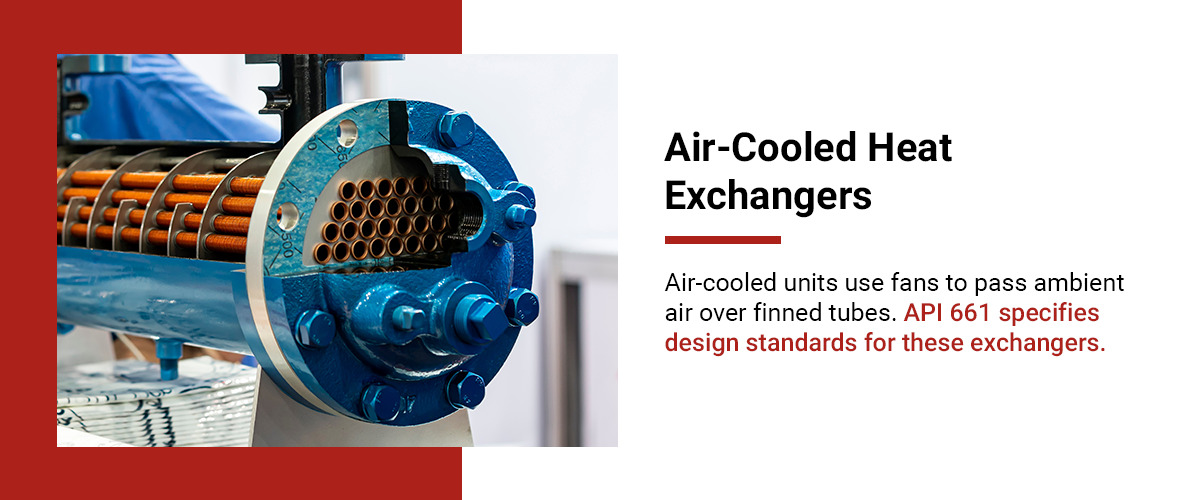
Air-Cooled Heat Exchangers
Air-cooled units use fans to pass ambient air over finned tubes. API 661 specifies design standards for these exchangers. No cooling water or auxiliary cooling fluid is necessary.
These systems work well in locations where cooling water is scarce or expensive. Air-cooled exchangers eliminate water treatment costs and discharge permitting.
Double-Pipe and Spiral Heat Exchangers
Double-pipe exchangers use concentric tubes for simple, small-capacity duties. One fluid flows through the inner pipe, while the other flows through the annular space between pipes.
Spiral heat exchangers wind two channels in a spiral pattern. This geometry provides excellent performance in fouling and slurry services. The spiral flow pattern creates a self-cleaning action that reduces maintenance intervals.
Materials Used in Industrial Heat Exchangers
Material selection determines service life and operating range. Corrosiveness of fluids, operating temperature and pressure all factor into material choice.
Carbon Steel
Common grades include SA-516 Grade 70 and SA-179. Carbon steel handles temperature ranges from minus 29 to 425° Celsius. Allowable stress drops significantly above 343° Celsius as the material loses strength at elevated temperatures.
Carbon steel provides a cost-effective solution for noncorrosive services. A corrosion allowance, typically 1/8 inch to 1/4 inch of extra wall thickness, accounts for gradual material loss over the exchanger’s service life.
Stainless Steel
Grades such as 304, 316L and duplex stainless steels cover a wider temperature range from minus 196 to 800° Celsius. These alloys retain better strength at high temperatures than carbon steel. The low carbon content in 316L prevents carbide precipitation during welding.
Titanium and Other High-Performance Alloys
Titanium Grade 1 and Grade 12 offer excellent corrosion resistance in seawater and highly acidic environments. Many titanium applications require zero corrosion allowance because the material forms a protective oxide layer.
Hastelloy and Inconel alloys handle even more severe conditions. These nickel-based alloys resist hot acids, chlorides and other aggressive chemicals that corrode stainless steel.
Industries and Applications
Industrial heat exchangers serve critical functions across multiple sectors.
Oil and Gas and Chemical Processing
Distillation columns, crackers and reactors all depend on precise temperature control. Heat exchangers in these services endure high pressures and temperatures with heavy fouling from process streams. Refineries can have hundreds of exchangers in a single unit.
Power Generation
Steam cycle condensers convert exhaust steam back to water for boiler feed. Large power plants use titanium tubes for seawater cooling because saltwater rapidly corrodes carbon steel and stainless steel.
Food and Beverage and Pharmaceuticals
Pasteurization and sterilization require precise temperature control to eliminate pathogens without degrading product quality. Sanitary 316L stainless steel designs allow for easy cleaning.
The Advantage of Used Heat Exchangers
Buying used equipment addresses real procurement challenges while maintaining operational reliability.
Lower Costs and Faster Timelines
Significant up-front cost savings compared to new construction make used exchangers attractive when capital budgets are tight. Immediate availability avoids the long manufacturing lead times that can delay project completion. Used process equipment ships faster because it’s prefabricated, inspected and ready for installation.
Reliability and Quality
Reputable suppliers provide decades of service from well-maintained used equipment. Quality depends on selecting suppliers who understand the equipment’s operating history and only sell units that meet specifications.
Find the Right Heat Exchanger for Your Plant Today
Understanding how heat exchangers function, from heat transfer principles to material selection and flow configurations, helps you make better procurement decisions that match your plant’s operating conditions. High-quality used heat exchangers deliver reliable performance at a lower cost with faster deployment than new construction.
Louisiana Chemical Equipment Company maintains an inventory of inspected, documented shell-and-tube, plate-and-frame and air-cooled units ready for immediate shipment. Browse our inventory of used heat exchangers, call us at +1-866-289-5232 or contact us online today to find the ideal equipment for your plant.
+1-225-923-3602 • sales@LCEC.com • plants@LCEC.com
Louisiana Chemical Equipment Company, L.L.C.
offers an extensive range of quality chemical process equipment and Complete Chemical Plants with competitive pricing.