Turbine lead times now stretch up to years, with equipment costs doubling or more in some markets. Cost-effective power generation now depends as much on sourcing strategy as it does on technical specifications.
The most successful projects balance equipment quality, capital expenditure and delivery speed. For many businesses, brand-new units are less feasible. The reliability and immediate availability of used industrial equipment are becoming more attractive.
The Financial Reality of Power Plant Development
Every piece of equipment you purchase during development will affect your facility’s financial performance for decades. The turbine you select sets your baseline fuel consumption. Generators determine conversion efficiency, and boilers establish your thermal ceiling.
Selecting machinery isn’t just a technical choice. Each piece is a financial commitment that influences everything from debt service to competitive positioning.
The market makes these decisions more complex. According to S&P Global’s May 2025 report, procurement teams ordering gas-fired turbines now face delivery windows ranging from one to seven years. Some markets have seen prices spike to 2.5 times pre-pandemic levels. Extended lead times delay commissioning and push financing costs higher.
Primary Equipment Systems and Budget Items
Four equipment categories drive the majority of your capital budget. When you’re building a power plant efficiently, these systems deserve early attention because they shape every downstream decision.
Power Turbines (Gas vs. Steam)
Gas turbines deliver fast starts, compact footprints and the flexibility to follow load changes. They’re the better choice for peaking plants and facilities that need to respond quickly to grid signals.
Steam turbines excel in baseload applications where waste heat can be captured and repurposed, favoring thermal integration and steady-state efficiency over rapid response.
If lead times for turbines are pushing your project timeline into risk territory, consider investing in a preowned turbine, which can be delivered immediately.
Electrical Generators
Generators convert mechanical shaft power into electrical output. An undersized generator leaves potential megawatts on the table, and an oversized unit inflates your capital budget without delivering proportional returns. Proper sizing requires matching the generator to your turbine’s output, expected load profile and grid requirements.
Preowned generators from established manufacturers arrive ready to install, often at half the cost of comparable new units. You get the same output capacity and grid compatibility without the wait or stress.
Boilers and Fuel Systems
The boiler determines how much heat you can extract from fuel and how efficiently that heat converts to steam. It sets the upper limit on turbine output. Fuel-handling infrastructure ensures the consistent delivery of the right fuel type, pressure and quantity.
If you’re designing a combined heat and power (CHP) facility, boiler selection becomes even more important. CHP systems capture waste heat and redirect it to industrial processes or thermal loads. The efficiency gains can be substantial, but only if the boiler is properly sized to serve both power generation and thermal demand.
Cooling Towers and Infrastructure
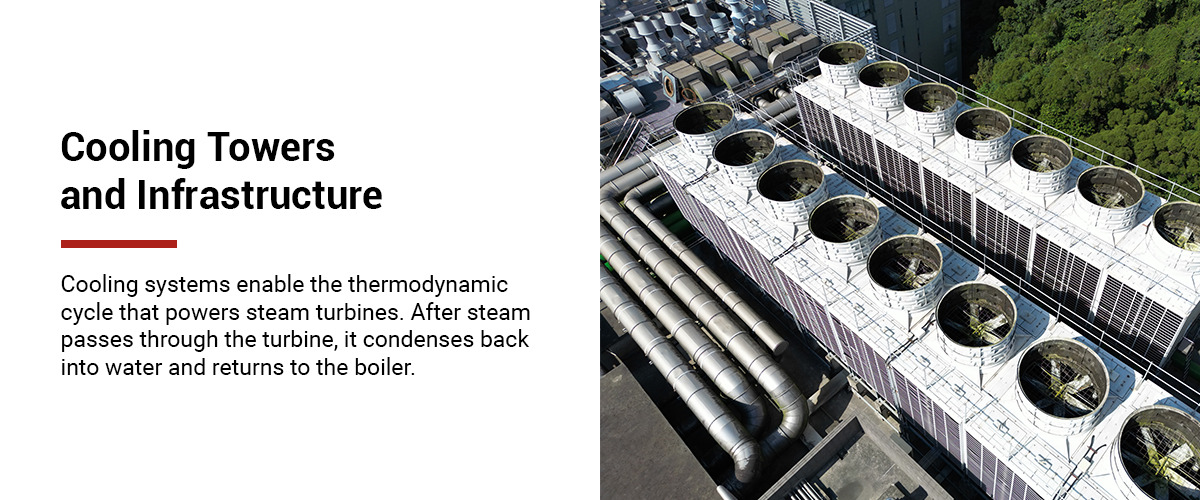
Cooling systems enable the thermodynamic cycle that powers steam turbines. After steam passes through the turbine, it condenses back into water and returns to the boiler. When you maintain lower condenser temperatures, you increase the temperature differential across the turbine. Effective cooling directly improves output and efficiency.
The cooling system includes towers, condensers, circulating water pumps, treatment systems and controls. Investing in high-quality used equipment can save capital here, too.
Key Specifications That Influence Total Project Cost
Purchase price is only one part of your capital budget. Total cost of ownership spans decades and includes fuel consumption, maintenance cycles and parts availability. Smart teams evaluate both.
Efficiency and Long-Term Operational Costs
Heat rate indicates how much fuel a plant consumes to produce 1 megawatt-hour of electricity. Lower heat rates mean lower fuel costs. Over 20 years, even modest efficiency improvements can compound into millions in fuel savings.
Efficiency also drives maintenance economics. More efficient machines run fewer hours to produce the same output, which reduces wear and lowers life cycle costs.
The U.S. Energy Information Administration incorporates both capital costs and heat rate performance into its generation cost models. Developers who optimize for efficiency and purchase price together get more value than those who focus only on the equipment’s initial expense.
Equipment Footprint and Site Integration
Every piece of equipment must physically fit on your site, connect to the infrastructure and meet clearance requirements. When equipment dimensions don’t align with site constraints, you face expensive workarounds.
Civil engineers may have to redesign foundations, electrical teams need to reroute cables and construction schedules can start slipping. These costs don’t appear on the equipment invoice, but they accumulate quickly.
Manufacturer and Model Reputation
Choosing proven manufacturers helps reduce risk. Established models come with documented performance histories, known failure modes and existing service networks.
Major OEM brands maintain global spares inventories and support multiple suppliers, which shortens repair timelines. For used equipment buyers, manufacturer reputation determines whether you’ll have access to firmware updates and engineering support as the equipment ages.
Common (and Costly) Equipment Sourcing Mistakes
You don’t want to prioritize finding cheap power plant equipment. Low purchase prices often correlate with higher operating costs, shorter service life or increased maintenance demands. The savings at purchase can disappear when fuel consumption runs high or downtime cuts into revenue.
Another common error is underestimating delivery timelines for new equipment. This hits gas-fired plants particularly hard, as turbine lead times now regularly extend into years. Late sourcing adds to the problem, leaving you with fewer options and less negotiating leverage.
Developers also underestimate how equipment choice affects construction sequencing, installation requirements, outage planning, service agreements and long-term operability. Equipment decisions made in isolation create downstream problems during construction and operation.
The Strategic Solution: Reducing Capex With Used Equipment
Preowned equipment delivers immediate capital relief. You’re paying a fraction of the new-build price for comparable performance and immediate delivery, which directly improves project economics. For developers working with constrained budgets, those capital savings can make the difference between a successful project and one that doesn’t work out.
The key is working with suppliers who provide transparency about equipment history. When you know the unit’s operating hours and maintenance records, you can make informed assessments. Investing in well-maintained used equipment for power generation from reputable sources can deliver reliable performance for decades to come.
Start Your Project on the Right Foot With LCEC
Louisiana Chemical Equipment Company specializes in sourcing high-quality used power generation equipment from within the industry. We offer transparent machine history, documented performance over time and immediate availability that new-build timelines can’t match.
Whether you’re sourcing turbines, generators, boilers or complete process systems, our team understands the financial and operational pressures you’re facing. Browse our extensive inventory to see what’s available now.
+1-225-923-3602 • sales@LCEC.com • plants@LCEC.com
Louisiana Chemical Equipment Company, L.L.C.
offers an extensive range of quality chemical process equipment and Complete Chemical Plants with competitive pricing.