The equipment used in industrial plants is at the heart of the operations. While it’s easy to focus on the complexity or fluidity of work in these systems, behind their reliable performance lies the material they are made from. Engineers carefully select each material based on its unique properties and how that fits into the final product’s applications.
Choosing the right material has many implications, from performance and lifespan to cost and safety. If you’re looking to buy processing equipment, it makes sense to learn about the materials used to build industrial plant equipment. This guide by Louisiana Chemical Equipment Company offers a look into each material’s advantages, trade-offs and applications.
Common Types of Materials for Industrial Equipment
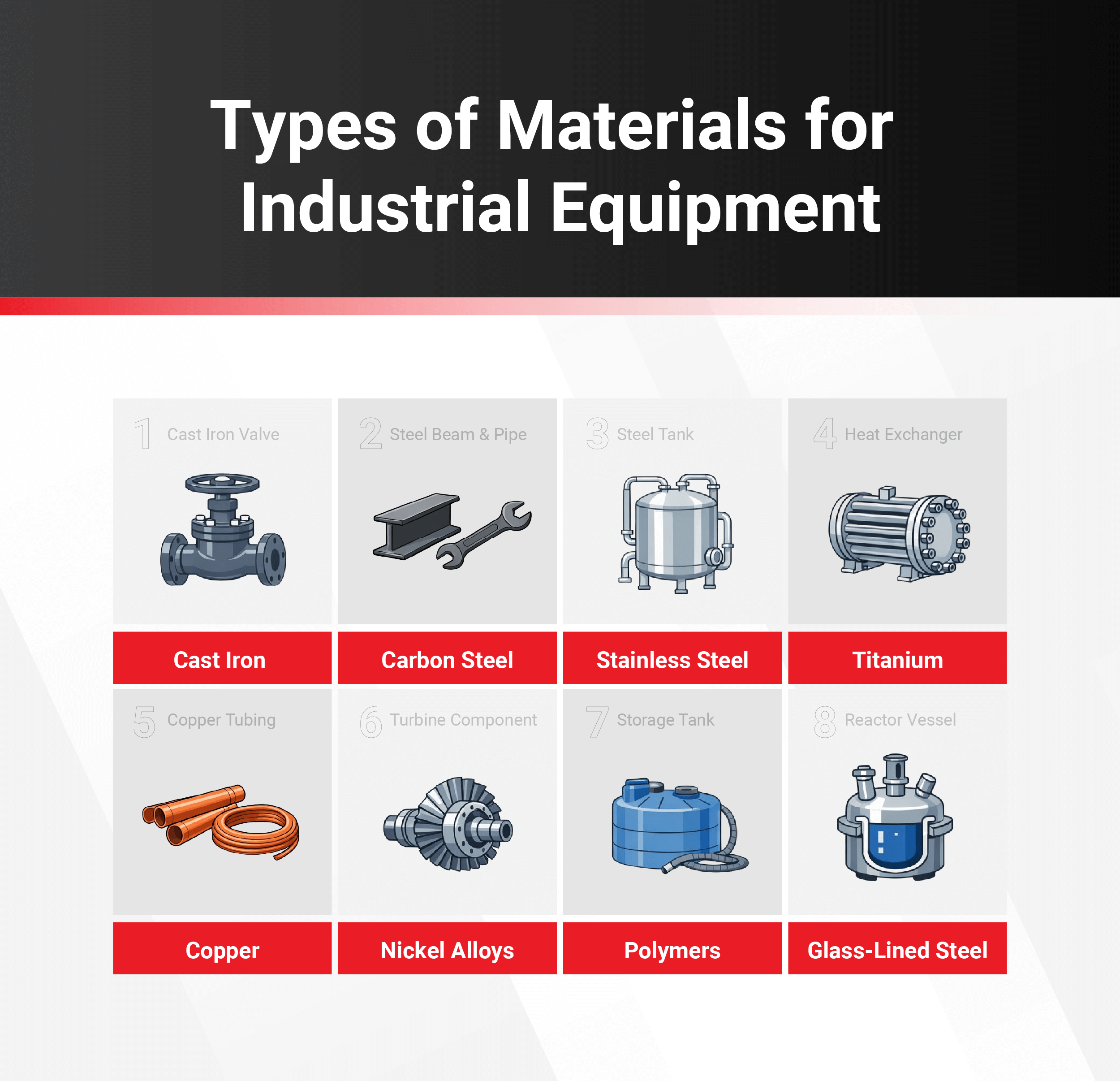
Here’s a breakdown of the commonly used materials, their distinct performance characteristics, strengths, limitations and applications:
Cast Iron
Iron is one of the oldest materials in manufacturing and also one of the most popular industrial plant materials due to its useful alloys. Cast iron, which contains 2% to 4% carbon, is an iron-carbon alloy with excellent qualities, such as ease of casting, strength against compression forces, vibration-damping and toughness. Its variation, known as ductile iron, is also widely used for its improved tensile strength.
Cast iron in general has many uses, such as in the manufacturing of valve bodies, pump housings, compressor casings, machine bases and piping systems. Iron gray, in particular, is a good choice for components that are not exposed to high tensile forces, such as machine bases and boiler parts.
Pros:
- Excellent castability: Its low melting point makes casting easy as it allows for complex shapes, reduced costs and fewer manufacturing steps.
- High compressive strength: It maintains strength under compression, making it ideal for structural support.
- Vibration damping: It absorbs vibrations, reducing wear and tear on mechanical parts, muffling noise and improving safety conditions.
- Durability: It exhibits excellent durability in noncorrosive environments, thanks to its high hardness and wear resistance.
Cons:
- Brittle: It has poor tensile strength and will break under tension instead of deforming.
- Prone to rusting: Since it’s composed mainly of iron, cast iron is prone to rust damage.
- Heavy: Cast iron is heavy, which can make it challenging to work with.
Carbon Steel
Carbon steel is also an iron alloy with a carbon content less than 2%. It’s the most widely used material in industrial plant construction because of its unique characteristics, balancing strength, ductility and cost. Carbon steel comes in varying carbon content and heat treatment preparations, which equip each type with distinct mechanical properties.
The applications of carbon steel can vary by industry, but it’s commonly used in oil and gas, power generation and chemical processing environments. It’s widely used for storage tanks, pressure vessels, pipelines, heat exchangers, boilers and structural supports.
Pros:
- Strength and hardness: The carbon content provides high strength and hardness, especially after heat treatment.
- Cost efficiency: It’s generally affordable and cost-effective compared to specialty alloys.
- Machinability: It’s easy to weld and fabricate with standard tools.
- Versatility: It’s readily available in many grades that are heat-treated to bring out specific characteristics.
- Recyclability: It’s highly recyclable, making it an environmentally friendly option.
Cons:
- Corrosion: Since it’s mostly iron, carbon steel is prone to rust in moisture environments and will corrode in acidic settings unless it’s covered in protective coatings.
- Brittleness: Like cast iron, carbon steel containing high carbon content can crack or snap under tension instead of bending.
Stainless Steel
Stainless steel is an iron and carbon alloy containing at least 10.5% chromium. It may also contain other alloying elements such as nickel and molybdenum to give it varying strengths, but it’s the specific ratio of chromium that makes it “stainless.” Chromium gives the steel a protective oxide layer that resists corrosion.
There are different grades of stainless steel with varying resistance levels to corrosion, temperature extremes and mechanical forces. You’ll find stainless steel across all industries. Its corrosion resistance makes it a common material for chemical processing equipment, pharmaceutical systems, reactors, heat exchangers and other applications.
Pros:
- Corrosion resistance: Unlike other iron alloys, stainless steel has excellent resistance to natural rusting. It also resists chemical corrosion effectively.
- Strength and durability: Depending on its thickness, it can withstand impacts and dents, and can last a lifetime if it’s not exposed to surroundings that cause degradation.
- Hygienic properties: It has a nonporous surface that gives it the stainless attribute, meaning it can resist mold, dirt and bacteria, and is easy to clean.
- Versatility: Stainless steel has many applications across various industries and is used in a wide range of products, from cookware and appliances to automotive parts and construction materials.
- Recyclability: Like other iron alloys, it’s highly recyclable and environmentally friendly.
Cons:
- High cost: It’s expensive up front compared to alternatives such as carbon steel or aluminum.
- Fabrication: Cutting, forming and welding are challenging due to the toughness.
- Weight: Stainless steel is dense and heavy, which can make it challenging to move and work with.
Titanium
Titanium is an exceptionally strong metal and the ninth most abundant element in the Earth’s crust. It has low density and is known for its excellent strength-to-weight ratio. The metal forms a protective titanium oxide layer on its surface, making it highly resistant to corrosive environments.
One of the main applications of titanium is in the aerospace industry because the metal is lightweight and resists high temperatures. It’s used in heat exchangers, condensers, reactors and piping systems exposed to harsh conditions. Chemical processing, desalination plants and power generation facilities are among the sectors that use titanium the most.
Pros:
- High strength: It has high strength and durability that matches some grades of steel and holds up well over time.
- Low weight: Due to its low density, titanium offers a high strength-to-weight ratio that makes it a lightweight strength option, usually in defense and aerospace industries.
- Corrosion resistance: It can resist rust and corrosion from chemicals and salt water, making it reliable in industrial and marine settings.
- Biocompatibility: It’s a nontoxic and hypoallergenic metal, making it useful for medical implants.
Cons:
- High cost: It’s expensive to produce and work with, and requires specialized tools to fabricate.
- Limited availability: It has limited availability compared to steel due to the energy-intensive extraction and processing required.
Copper
Copper is a metal with excellent electrical and thermal conductivity. It has long been used in industrial processes as the alloys brass and bronze, which have good corrosion resistance. Copper and its alloys are versatile, which makes them valuable in mechanical parts and products where their various strengths are desired.
For example, while the electrical conductivity makes copper useful in electronics, its malleability makes it reliable where ease of fabrication is necessary. Common applications include heat exchangers, electrical components, radiators and piping systems.
Pros:
- Electrical conductivity: It’s the second most electrically conductive metal and serves as the standard for electrical applications.
- Thermal conductivity: Due to the high thermal conductivity and melting point, it dissipates heat and doesn’t easily deform in high temperatures.
- Corrosion resistance: It can resist corrosion in environments with high moisture and salt levels.
- Workability: It’s malleable, making it easy to work with and fabricate into various shapes and sizes.
Cons:
- High cost: The material cost is high, which increases the cost of large-scale processing.
- Low strength: It has low mechanical strength and is not suitable for high-stress and high-pressure environments.
- Corrosion sensitivity: Although it displays fair resistance to corrosion, it cannot withstand aggressive conditions involving harsh chemicals.
Nickel Alloys
Nickel is a metallic element with versatile properties that make it valuable in industrial settings. It has various alloys that have unique compositions and properties, which are engineered to highlight specific advantages, such as strength, corrosion resistance and high temperature resistance.
Nickel alloys are valuable in a wide range of sectors. High-strength and corrosion-resistant alloys, such as Inconel® 718 and Waspaloy®, find widespread use in the aerospace, gas turbine, electrochemical and nuclear sectors. Whether they are used for strength, heat resistance or temperature resistance, each nickel alloy offers unique properties to handle specific conditions.
Pros:
- Corrosion resistance: The alloys have excellent resistance to various corrosive environments, whether it’s chemical processing or marine settings.
- High temperature resistance: Some of the alloys perform well in high-temperature settings, making them a popular choice in gas turbines, heat exchangers and furnaces.
- Strength and toughness: Due to their composition and heat treatment, some alloys offer superior strength, durability and creep resistance compared to many other metals.
- Versatility: Nickel can be alloyed with a variety of metals, such as chromium, iron, molybdenum and more, to bring out different characteristics.
- Electrical conductivity: They display excellent electrical conductivity, making them useful in electric wiring and heating elements.
Cons:
- High cost: The material cost alone is high.
- Machinability: They can be challenging to machine and weld, requiring specialized approaches.
Polymers
Polymers are synthetic materials designed to provide qualities such as chemical resistance, lightweight construction and cost efficiency. They are the most widely used materials in manufacturing after metals, and in some cases, they can replace metals. Where low weight, insulation and corrosion resistance are needed, polymers are ideal.
Common industrial polymers include polyethylene, polystyrene, polypropylene, Teflon and fiber-reinforced plastics. They are used widely across all industries to make products such as valves, linings, seals, piping systems, ducting and more.
Pros:
- Corrosion resistance: They have excellent resistance to corrosion and can withstand harsh chemical environments without degrading.
- Low weight: They have low density, which makes them suitable for lightweight applications.
- Excellent insulation: Besides the small conductive polymer category, most offer electrical and thermal insulation.
- Workability: Polymers can be molded into various forms.
Cons:
- Limited performance: They have low temperature and pressure limits compared to metals, and have reduced mechanical strength.
- Environmental concern: They are made from fossil fuels and cause resource strain and plastic pollution.
Glass-Lined Steel
This material blends glass with steel by applying a glass coating on steel surfaces at high temperatures. The process combines the mechanical strength of carbon steel with the corrosion resistance of glass, creating a surface that’s completely unreactive to chemicals.
Applications for glass-lined steel vary with industry. However, the material is typically used for chemical and pharmaceutical storage and mixing equipment.
Pros:
- Corrosion resistance: The glass lining is highly resistant to a wide range of corrosive elements.
- Product purity: It is chemically inert and doesn’t react with other products, avoiding contamination.
- Good thermal stability: It provides reliable stability in environments with temperature fluctuations.
Cons:
- Brittleness: The glass-lined surface is vulnerable to mechanical impact.
- Reduced performance: It has limited resistance to rapid temperature fluctuations and is incompatible with harsh chemicals that can damage glass.
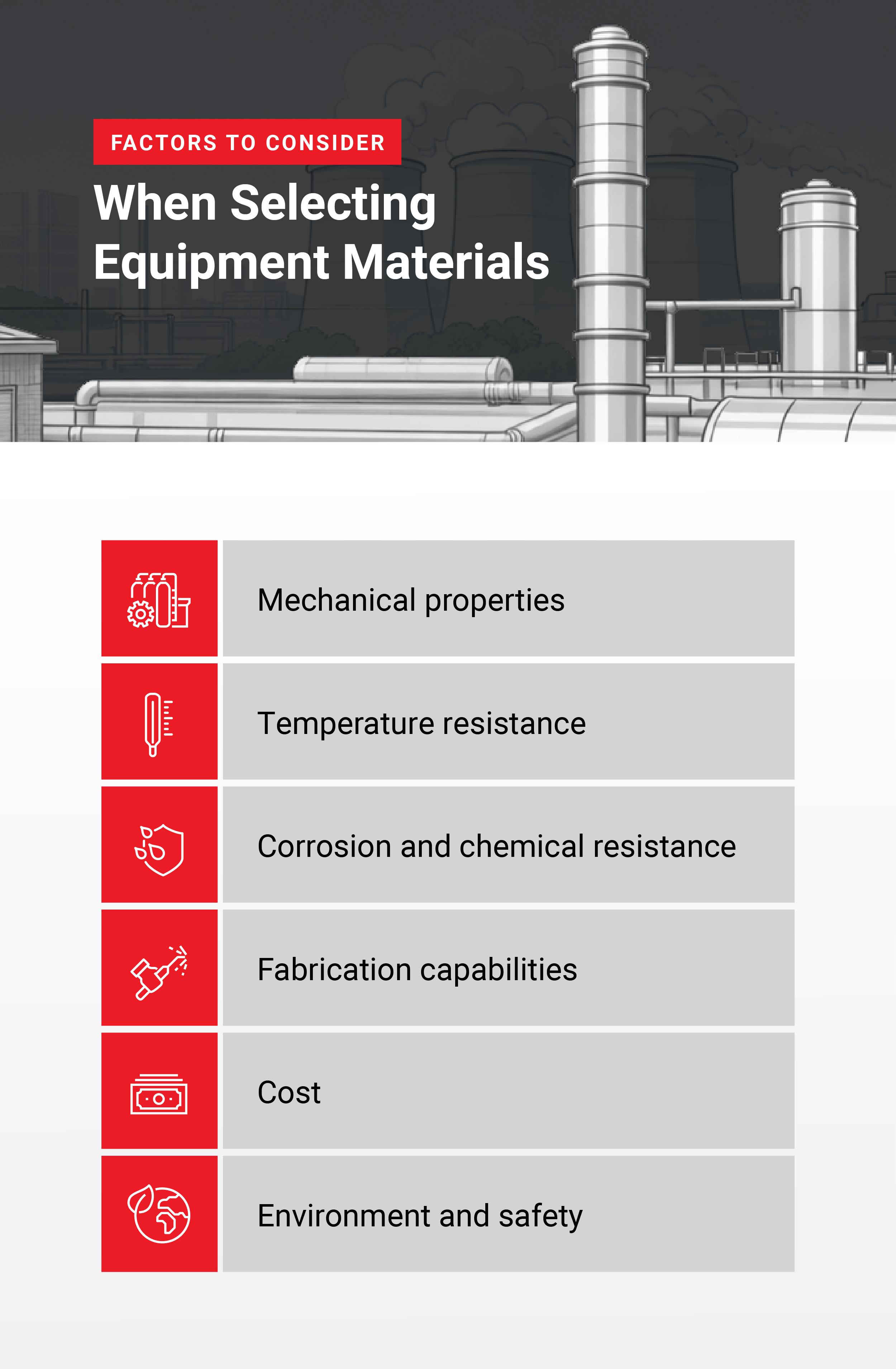
Factors to Consider When Selecting Equipment Materials
Matching material properties with operational demands is key to overall performance and durability. Here are the factors industrial plants should consider when selecting equipment materials:
Final Thoughts
Understanding how different materials impact overall equipment performance and reliability is key to selecting the right material. It’s also a decision that impacts safety, life cycle cost and regulatory compliance. Remember, no single material is superior overall because each comes with a unique balance of valuable features such as temperature tolerance, mechanical strength, workability and cost.
In the end, choosing the right material for plant equipment comes down to evaluating your processes, operating conditions, maintenance and the long-term cost of ownership.

Louisiana Chemical Equipment Company • Toll Free +1-866-289-5232 • International +1-281-471-4900
+1-225-923-3602 • sales@LCEC.com • plants@LCEC.com
Louisiana Chemical Equipment Company, L.L.C.
offers an extensive range of quality chemical process equipment and Complete Chemical Plants with competitive pricing.